


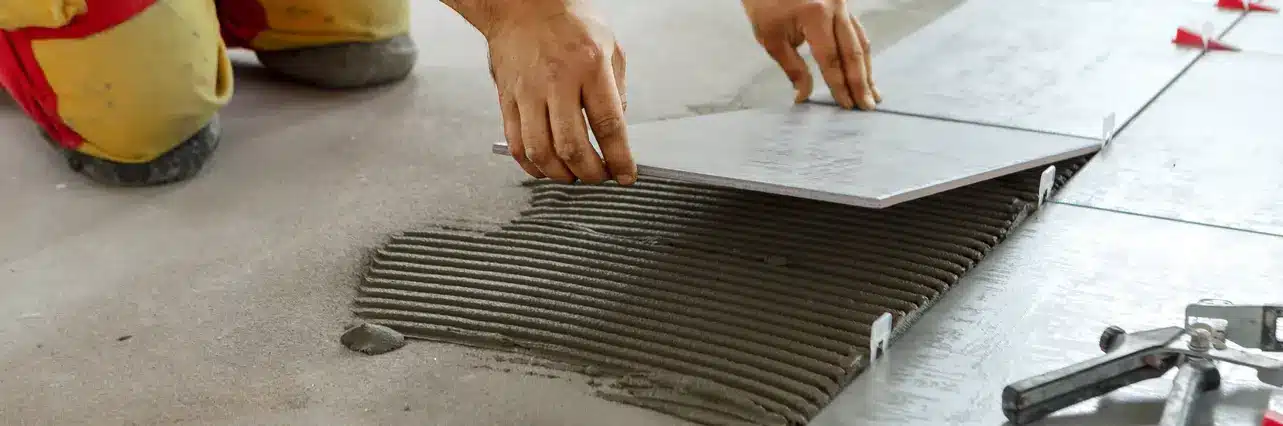
Step 1 – Ensure your screed is dry
- Before laying onto Calcium Sulfate screeds it is vital to ensure that the moisture content is at the correct level for the required floor finish.
- Typical values for moisture sensitive floor finishes are less than 0.5% Water by Weight (w/w) or less than 75% relative humidity (RH) for impermeable floors and less than 1% w/w for more permeable floors.
- As a general rule of thumb, the drying time for a Calcium Sulfate screed, so the moisture content reaches 0.5% w/w, is approximately 1mm per day up to 40mm in ideal drying conditions – i.e. air temperature of 20°C with a relative humidity not greater than 65%.
- Drying times will significantly increase for thicker screeds or those in poor drying conditions.
- If you do not have your own screed moisture meter, many adhesive or screed manufacturers offer a free moisture testing service – check in store for details.
Step 2 – Commission any underfloor heating
- Accelerated drying of calcium sulfate screeds may be used once the screed is at least 7 days old.
- It is at this point that any underfloor heating should be commissioned. The system should be increased by approximately 5°C per day until the maximum required working temperature is reached or as per the underfloor heating manufacturer’s recommendations.
- Maintain for a minimum of one week, before being gradually reduced to around 15-20°C. Do not exceed a temperature of 55°C. Use of dehumidifiers will also help.
Step 3 – Removal of laitance
- Before laying any tiles onto a calcium sulfate screed you must ensure that all laitance is mechanically removed from the surface.
- Laitance is a weak layer of fine particles deposited on the surface of the screed as the anhydrite cures. This layer is too weak to tile onto and can also inhibit drying of the screed.
- Remove laitance by abrasion using a suitable sanding machine i.e. a rotary floor scarifier with a 60’s grit sandpaper, scarifier or similar.
- Remove any excess dust completely with a vacuum cleaner
- Abrading of the surface canbe carried out 4-6 days after the application of the screed and can assist in the drying process.
- Scarify the surface even if you are tiling onto a low laitance anhydrite screed as this further aids adhesion.
Step 4 – Keep the screed protected
- All traffic should be kept off the screed until it has hardened sufficiently in accordance with the screed manufacturer’s instructions and should always be protected from contamination and damage from other trades.
- Protect the screed fully using boarding.
- If not protected from other trades it may result in the wearing or grinding down of the screed’s surface.
- Moisture should also be avoided as any reintroduction of water can result in damage to the screeds integrity.
Step 5 – Priming the screed
- Prime the screed with ARDEX P 51 Primer diluted 1:3 by volume with water (see Guide to Priming for more details) or where required, an epoxy primer such as ARDEX R 3 E blinded with Ardex Fine Aggregate.
Step 6 – Adhesive selection
- When selecting your adhesive consideration should be given to factors such as the tile type, size, and the type and method of cleaning the floor whilst in service – i.e. how wet the finished floor may become and what are the risks associated with limited water penetration.
- Slow or rapid-setting adhesives can be used such as ARDEX X77 or ARDEX X 7 R S1, depending on the tile type or environment.
- When the adhesive is cured, the joints between the tiles should be filled with a suitable flexible grout such as ARDEX FLEX FS or FLEX FL – please note that a minimum of 3mm for floor tiling is recommended.
Step 7 – Movement joints
- For ceramic tiling movement joints will be required in these installations. Any movement joint, or joints likely to be subject to movement, in the Calcium Sulfate screed should coincide with the movement joints in the tile bed. Movement joints should be incorporated as outlined in British Standard BS 5385-3, 2024.
-
 £12.90 - £208.38 ex. VATSelect options This product has multiple variants. The options may be chosen on the product page
 -
£115.90 - £410.19 ex. VATSelect options This product has multiple variants. The options may be chosen on the product page
-


