


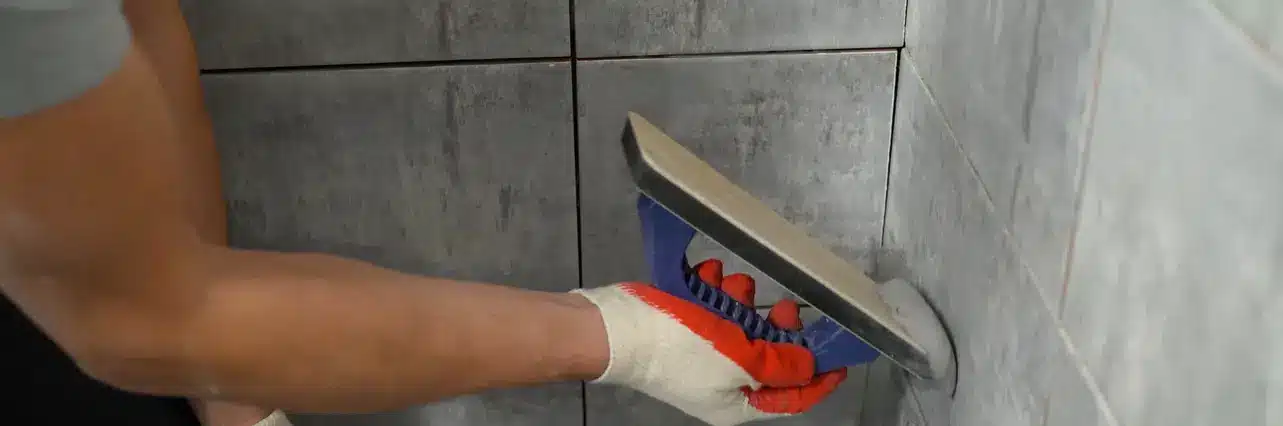
Step 1 – Ensure your grout lines are clean
- When tiling a wall or floor, make sure your grout lines are clean and free from any excess tile adhesive as this can affect the final appearance of the grout..
- Clean any excess dust or contamination off the tile surface and grout lines using a damp sponge and detergent where required.
- All grout lines should be clean, dry and free from loose debris.
Step 2 – Make sure your adhesive has fully dried
- Check the adhesive manufacturers instructions on set-time. Typically, ready-mixed adhesives take 24 hours to set, rapid-setting adhesives such as ARDEX X 77 S or ARDEX X 7 R S1 anything from 1.5-6 hours, and standard sets such as ARDEX X 77 or ARDEX X 7 from 16 hours plus.
- Remember set-times will vary depending on environmental conditions i.e. adhesives will set slower in colder temperatures and quicker in hotter conditions.
Step 3 – Remove all spacers
- Remove any spacers which are still embedded in your adhesive.
Step 4 – Grouting porous tiles in hotter temperatures
- If grouting porous tiles in temperature above 25°C, slightly dampen joints with clean water prior to grouting.
Step 5 – Selecting the right grout
- When grouting a power shower, wet room or swimming pool, we would advise using a cement-based wall and floor tile grout such as ARDEX FLEX-FS or ARDEX FLEX-FL, or where required, an epoxy grout such as ARDEX EG 18 Plus.
- ARDEX EG 18 Plus is a fully waterproof, hardwearing grout that is not affected by powerful jets, or extreme temperatures and humidity.
Step 5 – Mixing
- For ARDEX cement-based grouts, using a mixing bucket, slowly add the powder to clean cold water at a ratio as per the bag instructions.
- Mix using a bucket trowel or electric drill mixer at a slow speed (under 300rpm) until lump-free mortar is achieved.
- Allow the mixed grout to stand for 2-3 minutes before remixing for 30 seconds. Avoid entraining air by mixing at a too high a speed or by over mixing.
- For ARDEX EG 18 Plus, thoroughly mix the hardener (small container) into the resin into a uniform mortar is produced.
- Once the hardener and resin are mixed together, add in the filler.
- The use of a propeller type stirrer in a slow speed drill is advantageous.
- Mix slowly and thoroughly to a uniform colour. Do not over-mix or mix at too high a speed as this could cause air to enter the mixture.
- Back-mix the resin and hardener pots to ensure that no un-reacted resin and hardener remains before disposing, after curing, as a non-hazardous waste.
Step 6 – Check potential staining and damage risks
- Apply grout to a few tiles in a small trial area. If discolouration occurs, or difficulties are encountered with cleaning off (surplus grout), apply a protective sealer and repeat the process.
- For glass, some natural stone, profile trims, absorbent textured or soft ceramic tiles which may be vulnerable to surface scratching, test in a small inconspicuous area to ensure compatibility, or consult the tile manufacturer/ distributor for further advice. See also BS 5385: Part 1 for further information.
Step 7 – Application
- Work in small areas with a grout float or squeegee. Completely fill the tile joint with the mixed ARDEX EG 18 Plus grout and compact well, removing any excess grout from the tile surface as work proceeds.
- Clean off within the working time of 60 minutes using a sponge, emulsifying pad, or fine scotchbrite pad with a little clean water. Apply a gentle pressure and work in a circular movement to emulsify the residues on the face a provide uniform grout lines.
- Using a clean sponge, remove emulsified epoxy/water residue, cleaning diagonally to the grout lines.
- Allow the grout to dry.
Step 7 – Final clean down
- Clean any remaining light haze from the surface the next day using water and an emulsifying pad.
- Do not allow any surplus grout or haze to remain on the surface for more than 24 hours.
- If grouting a shower or wet room, do not use for at least 2 weeks as per British Standards.
-
 £47.00 ex. VATSelect options This product has multiple variants. The options may be chosen on the product page
 -
£7.13 - £22.25 ex. VATSelect options This product has multiple variants. The options may be chosen on the product page
-
£6.23 - £19.53 ex. VATSelect options This product has multiple variants. The options may be chosen on the product page


